
History - ffll- دانشکده زبانها و ادبیات خارجی
Language is an essential tool for learning what we do not know and for conveying what others do not know about us. It is only through language that one can understand other cultures and civilizations, and build bridges between the past and the present of human societies. Achieving the latest global scientific breakthroughs and establishing political, cultural, economic, and trade relations with other nations would be impossible without the mastery of language.
Contrary to popular belief, the Faculty of Foreign Languages and Literatures is not merely a center for language instruction. Alongside language acquisition, students—depending on their chosen tracks—engage with various disciplines closely related to language, including literature, translation studies, linguistics, and language pedagogy. With this perspective, the Faculty of Foreign Languages and Literatures is dedicated to leveraging all its resources to achieve these objectives.
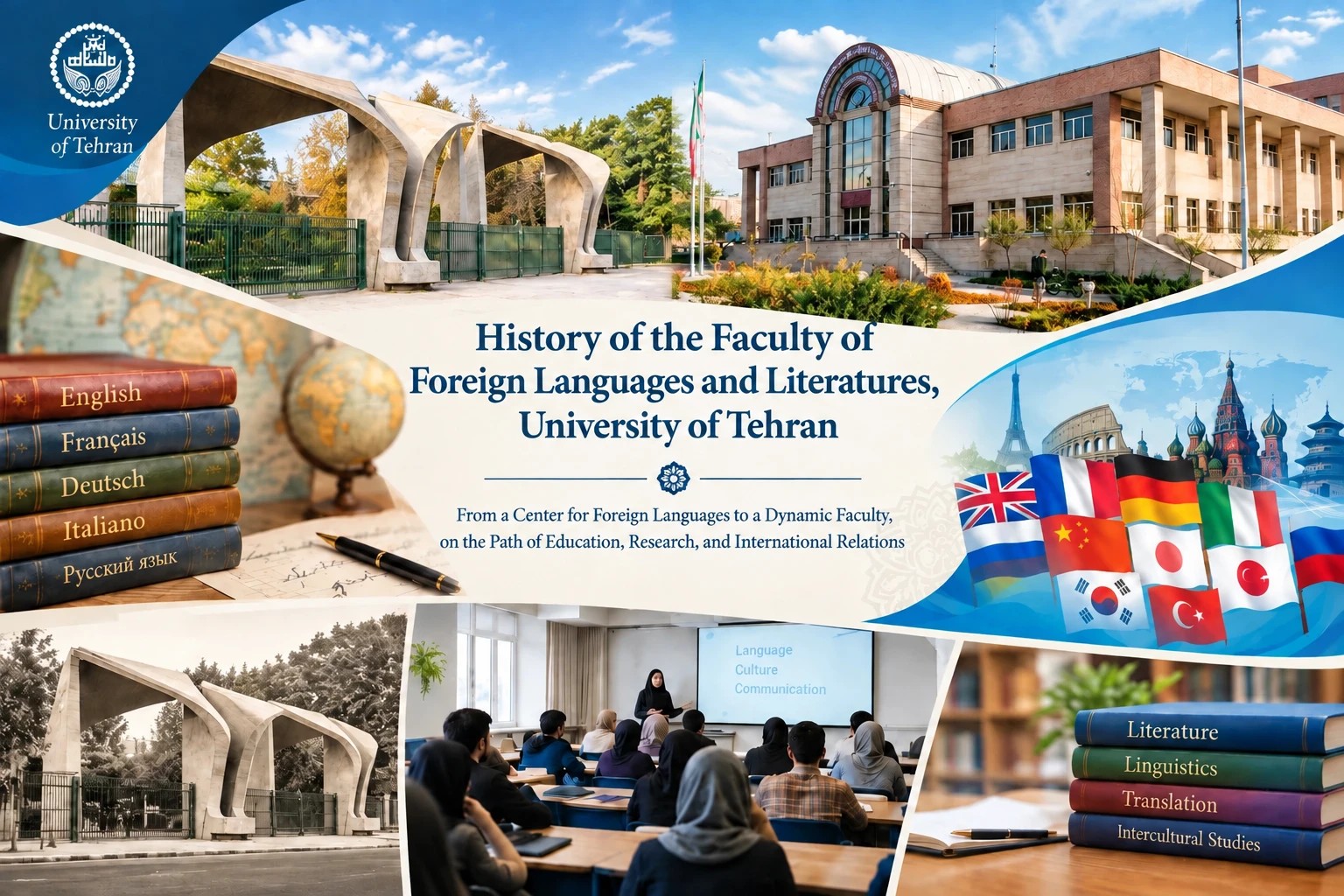
The history of the Faculty of Foreign Languages and Literatures at the University of Tehran dates back to 1969 with the establishment of the “Foreign Languages Center” within the Faculty of Literature. This center initially began its activities with the aim of developing foreign language education. Following various evolutionary stages, it officially continued its work as the “Faculty of Foreign Languages” in 1988. Consequently, the departments of English, French, Russian, Italian, and German language and literature—which had been active in the Faculty of Literature since the early years of the University of Tehran—were transferred to the new faculty.
Continuing its path of scientific and educational development, the Faculty later added the departments of Urdu and Japanese language and literature. In 2015, with the aim of strengthening cultural and scientific relations between Iran and China, the Chinese language program was established, and the Confucius Institute began its operations within the faculty. This trajectory of development reflects the Faculty’s commitment to expanding foreign language education and fostering scientific and cultural interaction with nations around the world.
In 2000, the Faculty relocated to its new premises in North Amirabad and has continued its educational, research, and cultural activities under the title of “Faculty of Foreign Languages and Literatures.” The expansion of educational facilities and infrastructure remained a priority in subsequent years. In 2024, by adding a new floor to the main building (Jondi-Shapur), the Faculty’s educational and administrative capacity was increased to better meet the needs of its students and support the Faculty’s developmental programs.
Today, the Faculty of Foreign Languages and Literatures at the University of Tehran, relying on its decades-long scientific and educational heritage, is moving forward in developing new disciplines, expanding academic tracks, and strengthening its Master’s and Ph.D. programs. Among the Faculty’s developmental plans are the establishment of new language programs—such as Turkish (Istanbul), Swedish, Korean, and Greek—as well as the expansion of graduate studies. With an approach rooted in specialized language and literature education, research, and international scientific and cultural engagement, this Faculty occupies a significant position in the landscape of foreign language education at the University of Tehran.